
AI delivers options in minutes.
Good decisions take more than that.
by
September 17, 2026
AI delivers options in minutes – people must decide. Why a sense of meaning is the precondition, and what leaders and HR can do in AI adoption.

If you are rolling out AI in your organization right now, you know the situation: the tools evolve so fast that every project plan is outdated almost as soon as it is written. Leadership is expected to invest, even though reliable numbers on the benefits are still missing. And HR often only gets involved once the rollout is well underway.
That is not negligence. AI starts out as an IT topic. It just doesn't stay one — because it changes something fundamental.
What is really changing
Options now appear quickly and in high quality. Where a draft used to take two days, three plausible versions are ready within minutes. One of them may be wrong, and you cannot tell by looking at it.
This creates a new and critical responsibility: evaluation. Anyone who cannot evaluate quickly and reliably loses the speed advantage again — either by hesitating or through extra rounds of sign-off that eat up exactly the time that was just saved.
What makes this remarkable: for decades, our processes were designed for stability and error avoidance. They were built so that individuals had to decide as little as possible. Approval chains, four-eyes principles and coordination loops largely replaced individual judgment. They worked because everything moved slowly enough.
Now we need exactly what those processes replaced: experience, professional intuition, and the ability and willingness to decide under uncertainty.
That takes two things: a framework in which bold decisions are possible. And people who are willing to make them.
Where does the willingness to decide boldly come from?
This willingness cannot be ordered. Anyone who decides boldly takes on responsibility — at the risk of being wrong. Hardly anyone does that for something that doesn't matter to them. The willingness grows where people experience their work as meaningful.
This is not about the corporate mission statement. A mission statement does not make any single decision right.
It is about something more everyday: experiencing your own work and your collaboration with others as meaningful — every day and over time, with or without a corporate purpose. That this sense of meaning is linked to retention, health and engagement is well supported by research¹. What is new is that it has now also become the precondition for capturing the speed advantage of the technology at all.
And AI adoption offers better starting points for this than almost any other initiative. Three of them are obvious.
First: experience carries more weight. When judgment becomes the scarce resource, experience and expertise gain value — after years in which process reliability made individual judgment largely dispensable. AI does not make the individual contribution smaller, but more important. That is the message that usually gets lost in the rush of implementation.
Second: collaboration changes. Organizations adopting AI go through an unusual phase: people experiment together, show each other what works, and learn across departments and hierarchy levels. Community and personal growth are important sources of meaning for many people. Both emerge almost by themselves in this phase. They just don't last by themselves.
Third: your own contribution becomes tangible. People who used to work within tight guidelines now decide for themselves — and experience something the old processes rarely allowed: their own contribution to the outcome. If the decision works out, it is a real success. If it doesn't, and the mistake is treated as a chance to learn, it is growth. Both require that people actually find out what became of their decision. Without that feedback, the decision has no consequence for the person who made it. And next time, they will play it safe again.
Which of these starting points resonates depends on the person. Research on meaning by Tatjana Schnell² shows that people draw on different sources of meaning — at work, for example, community, personal growth, achievement, challenge, care, and generativity: contributing to something beyond oneself. A corporate purpose primarily targets generativity. It barely reaches people who draw more on growth or challenge. That is why a single purpose statement is not enough here.
What people experience
When these starting points take hold, people have four experiences that strongly shape their motivation and sense of meaning:
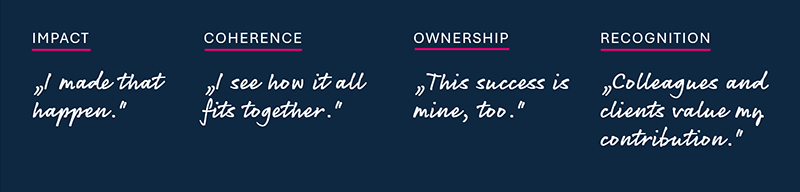
If, on the other hand, decisions are still made the old way — the AI delivers, but decisions still run through the usual loops — more than the time savings is lost. People also lose the connection between their work and the result, and nothing takes its place. This is often where what projects label as resistance, or attribute to individual technophobia, actually comes from.
This resistance is real and emotional — and that is exactly why it can change. It is not based on beliefs you would need to argue against, but on experiences. And experiences can be replaced by other experiences.
But the new ones don't happen by themselves. Creating them is a leadership task. HR provides the framework and the tools.
What leaders and HR can do in AI adoption
Clarify who decides — and allow for mistakes. When the AI delivers three versions: who chooses? That should be clearly defined. Equally important is an honest acknowledgment that some of these decisions will be wrong. That comes with working faster. If you define responsibilities but still hold mistakes against individuals, you get people who play it safe instead of deciding.³
Ask about tasks, not jobs. The usual question is: which jobs are affected? A more useful one: which tasks give people the sense that they make a difference? Automate first what nobody will miss. That way you avoid cutting exactly what motivates people — often for a small gain in time. You don't need a large survey. Two questions in your next team meeting are enough to start: What part of your work would you least like to give up? And what could go right away?
Make contributions visible. People should find out what became of their decisions. That can happen through feedback from the market, customer voices that reach the right people, or short meetings in which results are shared.⁴ It costs almost nothing. And it preserves what disappears first in times of upheaval: the willingness to go beyond what is required. It shows up in no metric — until it is gone.
Why this matters now — even in the middle of AI adoption
People form their interpretation of a change early and revise it late. Once someone has concluded that this is a cost-cutting program under a different name, they won't change their mind because a good workshop takes place six months later.
That sounds like bad news for everyone already in the middle of it. It isn't. AI adoption is not a project with an end date, but an ongoing process — the technology keeps evolving, and with it the way we work. Every new use case, every new feature opens a new window. Those who start early shape the first interpretation. Those who come in later work against an existing one. That takes more effort, but it is possible.
Either way, one thing holds: the effort grows with every step you let pass.
Technology expands what an organization can do. Whether it does the right thing is decided by people — and whether they want to depends on how much their work means to them.
Sources:
¹ Allan, B. A. et al. (2019). Outcomes of Meaningful Work: A Meta-Analysis. Journal of Management Studies.
² Schnell, T. (2025). The Psychology of Meaning in Life (2nd ed.). Routledge. Schnell, T., Höge, T. & Pollet, E. (2013). Predicting meaning in work: Theory, data, implications. Journal of Positive Psychology.
³ Edmondson, A. C. (1999). Psychological Safety and Learning Behavior in Work Teams. Administrative Science Quarterly.
⁴ Hackman, J. R. & Oldham, G. R. (1976). Motivation through the design of work. Organizational Behavior and Human Performance. Grant, A. M. (2008). The significance of task significance. Journal of Applied Psychology.
© 2026 Purposely.Coach®. All rights reserved. Sharing on social networks is expressly encouraged – please always include the source and a link to the original post. Any further use requires our prior consent.
(c) 2026 Purposely.Coach®. Dieser Artikel ist urheberrechtlich geschützt.
Teilen und Weitergeben in sozialen Netzwerken ist ausdrücklich erwünscht – bitte immer mit Angabe der Quelle und einem Link auf den Originalbeitrag. Jede weitere Nutzung (z. B. Abdruck, kommerzielle Verwendung) erfordert unsere vorherige Zustimmung.